Wolf is the thinking player’s game, and the one every app gets wrong. Four players, fixed tee order, and the Wolf rotates — player one is Wolf on the first hole, player two on the second, round and round.
The Wolf tees off last and watches everyone else hit. After any tee shot the Wolf can claim that player as a partner for the hole — but only right then, before the next swing. Pass on all three and the Wolf goes lone: one against three, for multiplied points.
| Player | Points after 18 | Settles |
|---|---|---|
| Mike | 5 | collects $20 |
| Sam | 1 | collects $4 |
| Tom | −2 | pays $8 |
| Dana | −4 | pays $16 |
Blind Wolf (on by default): declare lone BEFORE anyone tees off for a bigger multiplier — lone is commonly 2× points, blind 3×. Both multipliers are settings in TwoDown.
Holes 17 and 18: through 16 the rotation gives everyone four turns. Convention for the last two is a toggle — rotation just continues (default), or "last place picks" and the player furthest down is Wolf.
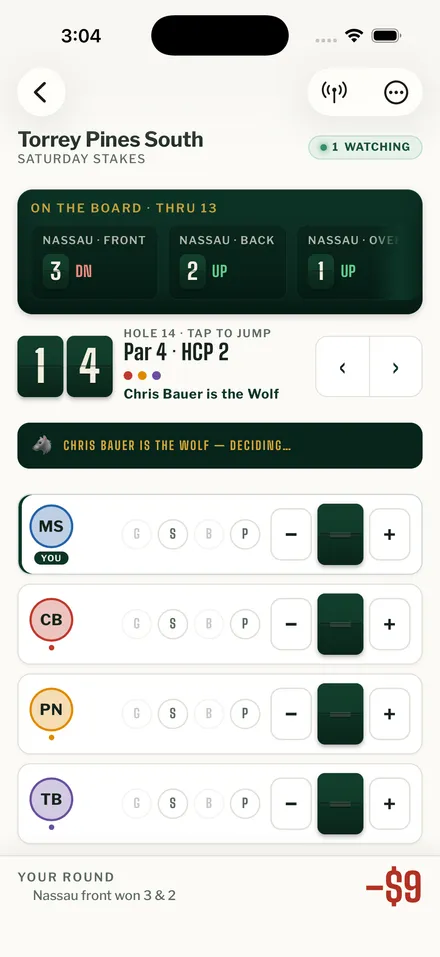
TwoDown shows who the Wolf is on every tee and captures the declaration in two taps — partner or lone. Scoring is best net ball, and the points board updates the moment the hole closes.
Declarations are decisions, not derived state. Edit a score later and the standings recompute, but the Wolf's pick stands — exactly like on the course.
Join the beta on TestFlightHow does the Wolf pick a partner?
The Wolf tees off last and watches. After each player's tee shot the Wolf can take them — but the pick must come immediately, before the next player hits. Pass on all three and the Wolf is lone, one against three.
How do points work?
Partners 2v2 — winners +1 each, losers −1 each. Lone Wolf wins — Wolf +3, each opponent −1 (then the lone multiplier applies, commonly 2×). Lone Wolf loses — Wolf −3, each opponent +1. Ties are zero. Every hole sums to zero.
Why is the settlement bigger than the point totals suggest?
Wolf settles pairwise — every pair squares the difference in their point totals at the point value. That's the universal Wolf convention, and it's why groups pick the per-point value carefully.
What if the Wolf's partner picks up?
The team plays its remaining ball. A side with no ball on a hole loses it to any side that has one.